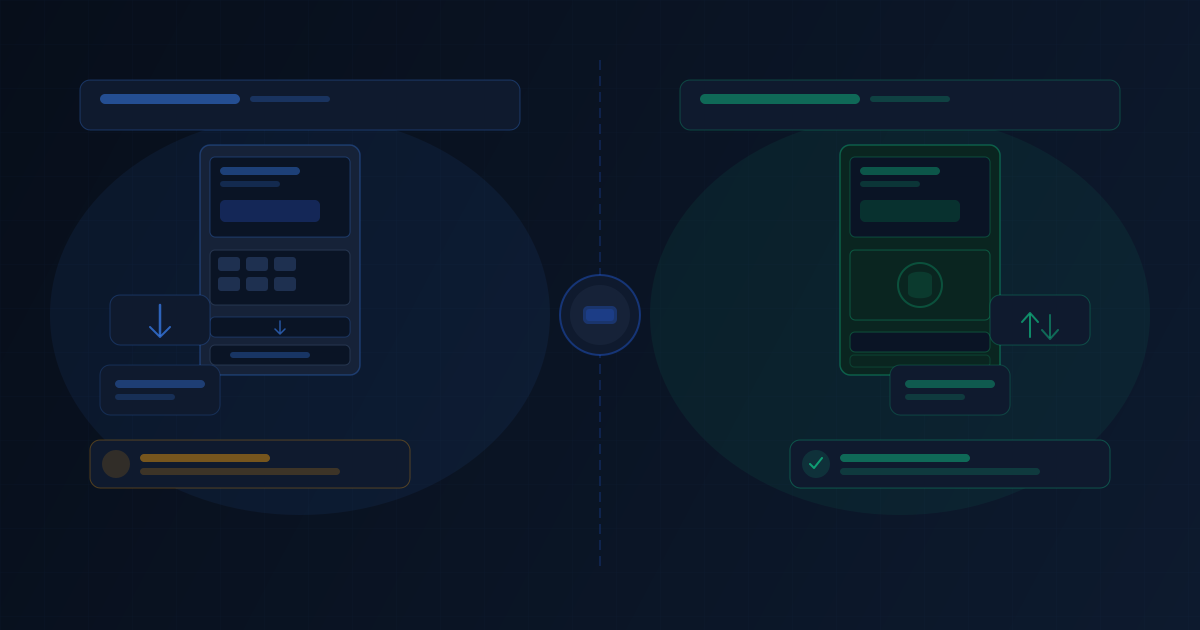
Cash recycling ATMs represent one of the most significant operational shifts available to businesses with substantial daily cash handling. But they cost 3–6× more than traditional ATMs, serve a fundamentally different purpose, and make sense for a narrower set of use cases.
Below is an honest analysis of both technologies: when recycling ATMs genuinely pay for themselves, and when a traditional ATM is the right, cheaper choice.
What Is a Cash Recycling ATM?
A traditional ATM performs one function: dispense cash to cardholders. Vault cash flows one direction – into customers’ hands.
A cash recycling ATM (also called a Teller Cash Recycler, or TCR) accepts deposits from cardholders or staff, authenticates and sorts the bills, and reuses deposited cash for future withdrawals. Cash flows both directions.
This “closed loop” dramatically reduces:
- How frequently the machine needs cash replenishment
- The total vault cash required to keep the machine operational
- Staff time spent counting, sorting, and transporting cash
For businesses handling large volumes of cash deposits daily – retail chains, supermarkets, restaurant groups, hotels – the operational savings can be substantial.
Traditional ATM: Cost and Revenue Profile
A standard traditional ATM at a convenience store generating 250 transactions/month:
| Item | Monthly Cost |
|---|---|
| Vault cash opportunity cost (3% on $8,000) | $20 |
| Cash loading labor (2 visits × 30 min × $20/hr) | $20 |
| Processor fees (250 txn × $0.38) | $95 |
| Maintenance/service contract | $55 |
| Total monthly cost | $190 |
| Surcharge revenue (250 × $3.00) | $750 |
| Net monthly profit | $560 |
A traditional ATM at the right location is a lean, high-return asset. Its weakness is entirely operational – vault cash goes out, never comes back.
Cash Recycling ATM: Cost and Savings Profile
A cash recycler deployed in a medium-volume retail environment (30,000+ bills handled monthly):
Initial acquisition cost: $15,000–$45,000 depending on manufacturer and configuration (vs. $2,000–$9,000 for a traditional ATM)
Monthly operational comparison:
| Operational Item | Traditional ATM | Cash Recycler | Savings |
|---|---|---|---|
| Cash replenishment labor | $120–$200/mo | $30–$60/mo | ~70% reduction |
| Vault cash required | $8,000–$20,000 | $3,000–$6,000 | 40–60% reduction |
| Vault cash opportunity cost | $25–$50/mo | $8–$18/mo | ~65% reduction |
| Cash counting/reconciliation | $300–$600/mo | $60–$120/mo | ~80% reduction |
| Counterfeit detection losses | Variable | Near-zero (built-in auth) | Significant |
| Total operational cost | $450–$850/mo | $100–$200/mo | ~70–75% reduction |
Payback period calculation for a high-volume retailer:
Additional cost: $20,000 (recycler vs. traditional) Monthly savings: $400/month Payback period: 50 months (4+ years)
For lower-volume operations, payback extends to 7–10+ years – making the ROI case very thin.
At higher volumes the payback accelerates: Businesses handling $50,000–$200,000+ in weekly cash transactions see dramatically better payback:
Monthly savings at high volume: $1,500–$4,000 Payback period: 8–18 months
When Cash Recycling ATMs Make Business Sense
The business case is strong for:
High-Volume Retail and Grocery
Supermarkets and large retail stores with multiple checkout lanes generate tens of thousands of cash transactions daily. Cash recyclers in back-office or teller positions dramatically reduce armored car visits (often from 5–7/week to 2–3/week), each visit costing $150–$400.
Casinos and Gaming Establishments
Gaming environments have uniquely high cash velocity. Cash recyclers at cage positions handle both deposits (buy-ins) and withdrawals (payouts), and their verification capabilities are critical for counterfeit detection in a cash-heavy environment.
Bank Branches and Credit Unions
Financial institutions were early adopters of cash recycling technology. TCRs at teller positions reduce teller cash drawer replenishment from a daily task to a weekly one, freeing teller time for higher-value customer interactions.
Large Hotel and Hospitality Operations
Hotels with active bars, casinos, or event spaces handling $100,000+ weekly in cash transactions benefit from centralized cash recycling at the cage or front desk.
Airport Retail and Currency Exchange
High transaction velocity combined with the need for multiple currency handling (international airports) makes cash recycling technology particularly valuable.
When Traditional ATMs Are the Right Choice
For the majority of ATM deployments, a traditional ATM is the correct choice:
- Independent ATM route operators – Surcharge revenue generation is the goal; deposit functionality isn’t needed
- Convenience stores and gas stations – Cash handling volume rarely justifies a recycler
- Bars and restaurants – Night-time cash deposits are better handled by a night drop safe
- Any location with under $20,000 weekly cash handling – The operational savings rarely justify the premium
A traditional ATM generating $600/month in net surcharge revenue pays back its $2,500 acquisition cost in 4 months. A cash recycler at the same location might save $100/month in operational costs but requires 20+ years to recover its premium over the traditional option.
Leading Cash Recycler Manufacturers in 2026
Nautilus Hyosung MoniMax 8000TA
Hyosung’s flagship recycler offers strong performance in the North American market with good parts availability and service network.
| Spec | Detail |
|---|---|
| Note capacity | 4,800 recycled + 2,000 deposit |
| Recognition speed | 1,200 notes/min |
| Denomination recognition | $1, $5, $10, $20, $50, $100 |
| Counterfeit detection | UV, magnetic, infrared |
| Price range | $18,000–$28,000 |
GRG Banking S90
GRG is a strong contender in the enterprise segment with competitive pricing and robust software integration.
| Spec | Detail |
|---|---|
| Note capacity | 4,000 recycled notes |
| Recognition speed | 1,500 notes/min |
| Software | GRG CashFlow Manager |
| Price range | $15,000–$25,000 |
Diebold Nixdorf Opteva 328
Diebold’s recycler series targets financial institutions with premium build quality and enterprise integration.
| Spec | Detail |
|---|---|
| Note capacity | 4,000 notes |
| Software | DN Series Software Suite |
| FI integration | Core banking API support |
| Price range | $22,000–$40,000 |
NCR APTRA Interactive Teller
NCR’s recycler is designed for the financial institution market and offers strong integration with their APTRA software suite.
| Spec | Detail |
|---|---|
| Note capacity | 3,200 notes (configurable) |
| Software | NCR APTRA Edge |
| FI integration | Full core banking connectivity |
| Price range | $25,000–$45,000 |
Side-by-Side Comparison
| Feature | Traditional ATM | Cash Recycler |
|---|---|---|
| Acquisition cost | $2,000–$9,000 | $15,000–$45,000 |
| Cash flow direction | Dispense only | Dispense + accept |
| Vault cash required | $5,000–$20,000 | $3,000–$8,000 |
| Cash replenishment frequency | 2–7×/week | 1–2×/week |
| Counterfeit detection | Basic | Advanced (multi-sensor) |
| Ideal for | Surcharge revenue | Cash operations efficiency |
| Payback period | 4–8 months | 8 months–5+ years |
| Maintenance complexity | Low | Medium–High |
| Service network availability | Wide | Narrower |
✓ Cash Recycler Advantages
- Dramatically reduces cash handling labor
- Fewer armored car visits = lower transport costs
- Built-in counterfeit detection on all bills
- Less vault cash required (lower opportunity cost)
- Reduces reconciliation errors and cash overages/shortages
✕ Cash Recycler Disadvantages
- 3–6× higher acquisition cost
- Long payback period at most deployments
- More complex maintenance and service requirements
- Narrower service technician network
- Not designed for surcharge revenue generation
Decision Framework
Ask these four questions to determine which technology fits your situation:
1. What is your primary objective?
- Generate surcharge revenue → Traditional ATM
- Reduce cash handling costs → Cash Recycler
2. How much cash does your business handle weekly?
- Under $20,000 → Traditional ATM
- $20,000–$50,000 → Borderline; run specific ROI calculation
- Over $50,000 → Cash Recycler warrants serious evaluation
3. What is your armored car visit frequency?
- Under 3 visits/week → Traditional ATM
- 4+ visits/week → Cash Recycler can reduce this significantly
4. What is your acceptable payback period?
- Under 24 months → Traditional ATM (almost certainly)
- 24–48 months → Cash Recycler at medium-high volume locations
- 48+ months acceptable → Cash Recycler for large operations with strong operational savings
Pricing ranges reflect 2026 market conditions. Obtain quotes from authorized distributors before making purchasing decisions.
Have an ATM product or service?
Reach decision-makers with a sponsored guide on HM Cash.