Interactive Teller Machines represent the most significant evolution in physical cash infrastructure since the original ATM. By combining a traditional cash dispenser with a live video connection to a remote teller, ITMs can perform most teller transactions – including complex ones a standard ATM cannot – while reducing branch staffing costs by 40–70%.
For the right organizations, the economics are compelling. But ITMs are expensive, operationally demanding, and unsuited to many deployments where a standard ATM (or nothing) is the better answer.
What Is an Interactive Teller Machine?
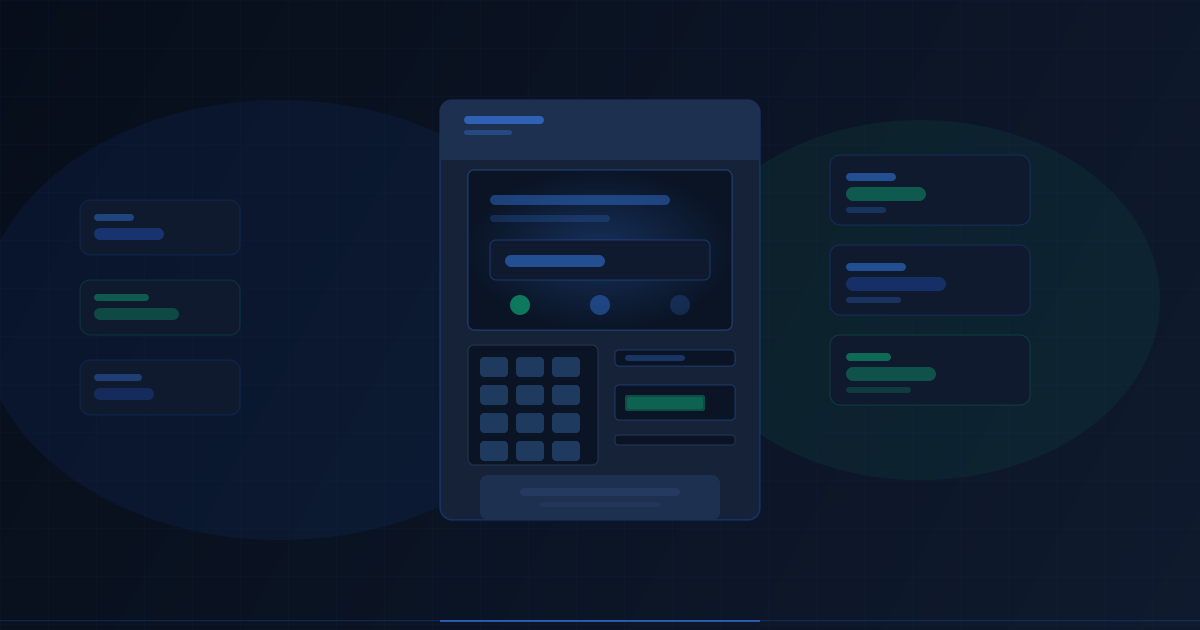
An ITM looks similar to a full-service ATM but includes:
- A large, high-resolution touchscreen (typically 15–21 inches)
- A two-way HD video camera for live teller interaction
- An audio system with privacy handset
- A cash dispenser and acceptor (full two-way cash handling)
- A check scanner/deposit module
- A card reader and PIN pad
- A receipt printer
- Optional biometric authentication (fingerprint or palm vein)
In ATM mode, the ITM operates as a standard full-service ATM with no teller involvement – card-based withdrawals, deposits, balance inquiries, and account management.
In Interactive Teller mode, a customer presses a button to connect via video to a live remote teller, who can then:
- Process loan payments
- Handle account opening requests
- Issue temporary debit cards
- Process foreign check deposits
- Assist with complex transaction issues
- Provide the full range of teller services except physical signature documents
The Core Business Case for ITMs
The ITM value proposition is primarily operational cost reduction for financial institutions:
Traditional branch teller model:
- 2 tellers per shift × 3 shifts × 5 days = 30 teller-hours/day
- At $18–$22/hour fully loaded: $540–$660/day in labor
- Per year: $197,000–$241,000 in teller labor for a basic branch
ITM model (single ITM, shared remote teller center):
- ITM equipment: $35,000–$65,000 (one-time)
- Remote teller center labor (1 remote teller handles 4–8 ITMs): $90,000–$120,000/year for shared portion
- ITM maintenance: $3,000–$6,000/year
- Annual cost per ITM: $30,000–$45,000 (assuming teller center is shared across multiple ITMs)
For a credit union replacing a $200,000/year branch with 2 ITMs serviced by a shared teller center:
Annual savings: $200,000 − (2 × $37,500) = $125,000/year Equipment payback: ~$130,000 ÷ $125,000 = ~13 months
These figures make the ROI case compelling for financial institutions. The calculation changes significantly for retail businesses and non-bank deployments.
ITM Use Cases: Where They Make Sense
1. Credit Union Branch Transformation
Credit unions are the fastest-adopting segment for ITM technology. Many have converted traditional branch locations to ITM pods – reducing footprint from 2,000 sq ft to 400 sq ft – while maintaining full service access via remote tellers.
Case study profile: A 12-branch credit union replacing 3 underperforming branches with dual-ITM locations:
- Eliminated 12 FTE positions (natural attrition + reassignment)
- Reduced real estate costs by $420,000/year (lease savings)
- Member transactions maintained at 94% of prior levels
- Implementation cost: $380,000 total
- Annual savings: $650,000 from labor + real estate
- Payback: 7 months
2. Bank Branch Right-Sizing
Community banks and regional bank branches with declining transaction volumes use ITMs to reduce labor costs while maintaining a physical footprint for brand presence and complex transactions.
3. Extended-Hours Service
ITMs allow financial institutions to offer live teller services outside traditional banking hours – evenings and weekends – through the shared remote teller center model. This is particularly valuable for retail banking customers who can’t visit branches during business hours.
4. Rural/Underserved Location Coverage
ITMs can provide full-service banking to communities that don’t generate enough transaction volume to justify a staffed branch. A single ITM in a rural grocery store can serve as the primary banking touchpoint for thousands of residents.
5. Employer-Site Banking Partnerships
Large employers (hospitals, universities, corporate campuses) often partner with financial institutions to place ITMs in employee common areas. The employer benefits from providing a financial service benefit; the FI benefits from branch-equivalent access at low cost.
When ITMs Don’t Make Sense
For the majority of ATM operators and retail businesses, ITMs are the wrong technology:
Independent ATM route operators: ITMs require dedicated remote teller staffing, backend banking system integration, and ongoing video infrastructure maintenance. None of these exist in a typical ATM route operation. The revenue model doesn’t support it.
Retail businesses adding a cash access point: A standard ATM at $2,500–$5,000 with $600/month net surcharge revenue is vastly simpler and more profitable than a $45,000 ITM requiring banking system integration.
Low-transaction-volume locations: The cost savings from ITMs are realized by replacing expensive in-person teller labor. If there’s no teller labor to replace, there are no savings.
Businesses without banking system integration capabilities: ITMs are fundamentally banking infrastructure. They require integration with core banking systems – something a retail business or independent operator simply doesn’t have.
Leading ITM Manufacturers in 2026
NCR Interactive Teller
NCR is the market leader in ITM technology globally, with the largest installed base and the deepest integration capabilities.
| Spec | Detail |
|---|---|
| Screen | 19-inch high-brightness display |
| Video | 1080p with echo cancellation |
| Cash handling | Full dispense + accept + recycling |
| Check handling | Multi-check simultaneous scanning |
| Biometrics | Palm vein + fingerprint (optional) |
| Software | NCR APTRA Interactive Teller |
| Price range | $40,000–$65,000 |
| Best for | Banks and credit unions with 10+ ITM deployments |
Diebold Nixdorf DN-Series ITM
Diebold’s ITM series offers strong build quality and deep integration with their DN software suite.
| Spec | Detail |
|---|---|
| Screen | 21-inch touchscreen |
| Video | 4K with AI-enhanced audio |
| Cash handling | Full recycling capability |
| Core integration | Open API + 50+ core banking connectors |
| Price range | $45,000–$70,000 |
| Best for | Larger banks, full-service deployments |
Hyosung MoniMax ITM
Hyosung brings strong value engineering to the ITM segment, offering competitive pricing for mid-tier financial institution deployments.
| Spec | Detail |
|---|---|
| Screen | 17-inch display |
| Video | 1080p dual-camera |
| Cash handling | Dispense + accept (recycling optional) |
| Price range | $35,000–$55,000 |
| Best for | Credit unions, community banks, first ITM deployments |
CorServ ITM Platform
CorServ takes a software-focused approach – their platform can be deployed on compatible third-party hardware and specializes in the remote teller center operational model.
| Spec | Detail |
|---|---|
| Model | Software platform |
| Hardware compatibility | NCR, Diebold, Hyosung |
| Remote teller center tools | Specialized scheduling, metrics, and management |
| Price | Per-transaction or monthly license |
| Best for | FIs building centralized remote teller operations |
ITM vs. ATM vs. Traditional Branch: Comparison
| Factor | Traditional Branch | ATM | ITM |
|---|---|---|---|
| Transaction types | Unlimited | ~20 (card-based) | ~200 (nearly full-service) |
| Annual cost (typical) | $200,000–$400,000 | $3,000–$12,000 | $30,000–$80,000 |
| Staffing required | 2–8 FTE | None | Remote teller (shared) |
| Hours of operation | Business hours | 24/7 | Extended (8am–8pm typical) |
| Complex transactions | Yes (in person) | No | Yes (via video) |
| Real estate footprint | 1,500–3,000 sq ft | 10–15 sq ft | 50–200 sq ft |
| Customer satisfaction | High | Medium | High (when well-managed) |
| Implementation time | 3–6 months | 1–2 weeks | 2–4 months |
ROI Model Template for Financial Institutions
Run through this framework before committing to an ITM deployment:
Step 1: Calculate current branch teller labor cost
Annual teller FTE cost × number of FTE = Annual labor cost
Step 2: Estimate ITM equipment and implementation cost
ITMs × average unit cost + integration + installation = Capital cost
Step 3: Estimate annual ITM operational cost
(Remote teller labor allocation per ITM + maintenance) × number of ITMs = Annual operational cost
Step 4: Calculate annual savings
Annual labor cost − Annual ITM operational cost = Annual savings
Step 5: Calculate payback period
Capital cost ÷ Annual savings = Payback period (years)
A 24-month payback or less typically makes the deployment decision clear. 24–48 months warrants consideration of qualitative factors (member experience, competitive positioning). Over 48 months: the financial case is weak.
✓ ITM Advantages
- Full teller-equivalent service at fraction of branch cost
- Extended hours without overtime labor cost
- Reduced real estate requirement
- Consistent service quality (vs. variable teller performance)
- Enables rural/underserved location coverage
✕ ITM Disadvantages
- High upfront capital cost ($35K–$70K per unit)
- Requires remote teller center investment to operate
- Complex banking system integration required
- Not suitable for non-banking deployments
- Customer adoption requires active staff promotion
Key Questions Before Investing in ITMs
- Do we have the transaction volume to justify replacement of in-branch tellers? If you’re adding teller capacity, not replacing it, the ROI model changes.
- Do we have or can we build a remote teller center? The ITM is only part of the investment; the teller operations behind it are the other half.
- What is our core banking system, and which ITM manufacturers have proven integrations with it?
- What does our member/customer demographic look like? Older demographics have lower ITM adoption rates – factor this into your transaction projections.
- Are we deploying 1 or 10+? A single ITM deployed in isolation has poor economics. The shared remote teller cost structure rewards scale.
ITM pricing and specifications subject to change. Consult manufacturer representatives and integration partners for current quotes and implementation timelines.
Have an ATM product or service?
Reach decision-makers with a sponsored guide on HM Cash.